

Summary of an essay first published on Substack on November 22, 2026.
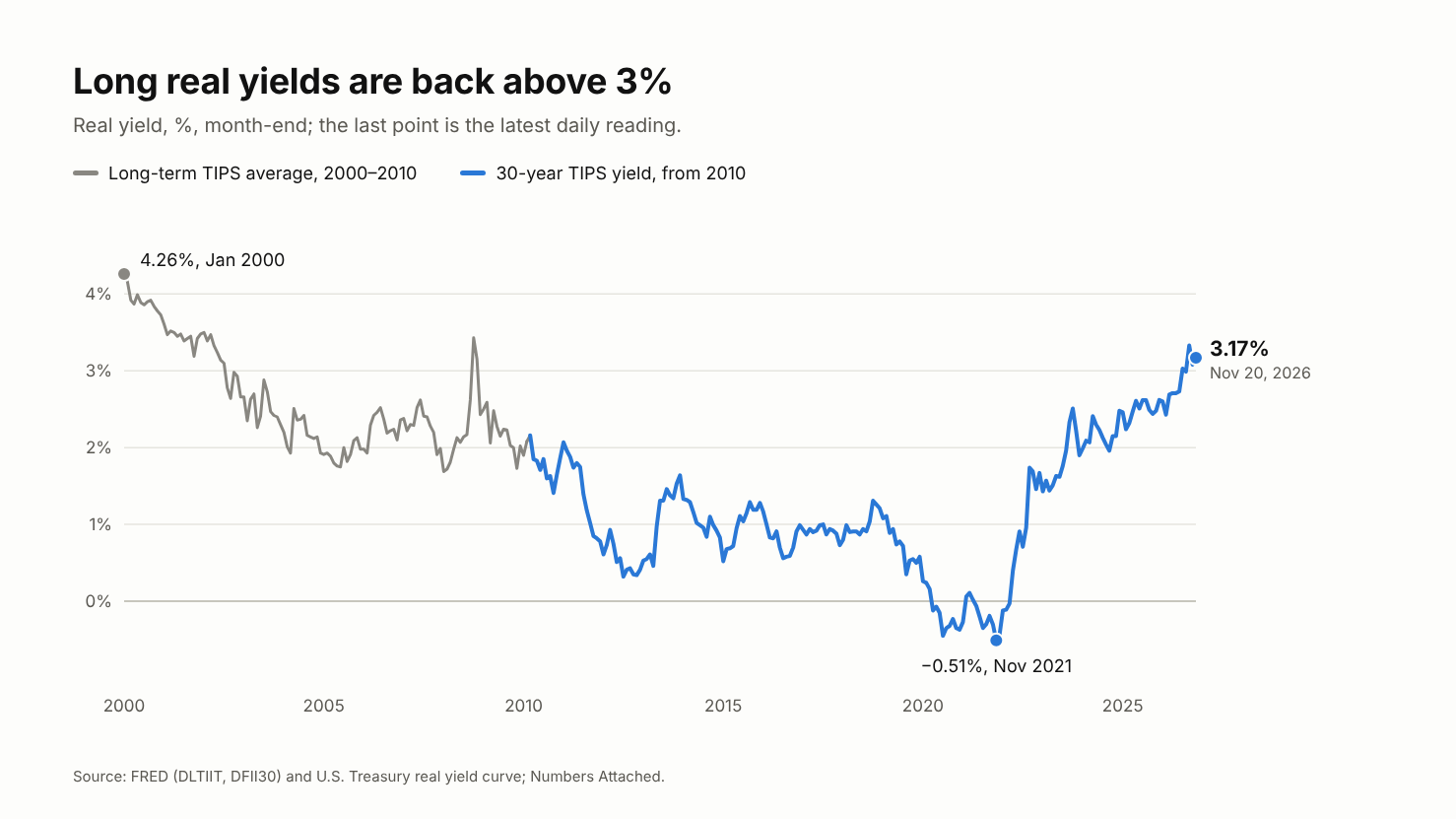
The thirty-year Treasury Inflation-Protected Security (TIPS) yields about 3.2% above inflation, and long real yields are above 3% for the first time since 2008. Five years ago the same maturity yielded less than zero. On Thursday, November 19, the Treasury sold $19 billion of ten-year TIPS at 2.90% over inflation, the highest yield at a ten-year auction since July 2002.
A nominal bond promises dollars and says nothing about what they will buy. A two-year Treasury note bought at about 10% in late 1978 returned 21% more dollars two years later and 5% less purchasing power. Inflation-linked bonds were the answer: Britain began selling them in 1981 and the United States in 1997.
The yield at purchase decides the outcome. Thirty-year TIPS bought at minus 0.5% in 2021 locked in a loss of about 14% of purchasing power over the life of the bond, and marked to market they have since lost more than half their value. In Britain, an index-linked gilt maturing in 2073 was sold in November 2021 at £356 for every £100 of face value and traded near 50 ten months later, a fall of 86%. Inflation protection does not protect against the price paid for it.
Today the insurance costs less than the thing insured. Breakeven inflation, the rate at which TIPS and ordinary Treasuries pay the same, is about 2.15% at both ten and thirty years. Inflation is running near 4%, and the Cleveland Fed’s model expects 2.7% a year over the next decade. One recent study measures risk by the inflation-adjusted spending a portfolio can fund over fifty years. By that yardstick long TIPS are the calmest asset, long nominal bonds are more than twice as risky and Treasury bills five times as risky.
Four risks remain. The first is price: a rise of one percentage point in the real yield takes about 18% off a thirty-year TIPS, and that yield ranged between 3.05% and 3.37% from early October to November 20. The second is measurement: TIPS pay on the consumer price index as first published, the index is never revised, and a change of method could reduce what they pay. The third is the deflation floor, which protects face value and not a premium paid above it; today’s issues trade below par. The fourth is tax. For U.S. taxpayers the inflation adjustment to principal is taxed each year as ordinary income, although no cash arrives until maturity, so the after-tax real yield shrinks as inflation rises unless the bond is held in a tax-advantaged retirement account.
Price risk runs both ways, and unevenly. A fall of one percentage point in the real yield would add about 23% to the price of a thirty-year TIPS, while a rise of the same size would take about 18% off. That asymmetry is convexity, and a thirty-year bond has more of it than shorter ones. It is arithmetic, not a forecast: nothing requires real yields to fall.
The same rise in real yields sits behind several of this autumn’s worries. Long nominal bonds are the most exposed: a thirty-year Treasury at about 5.3% carries roughly 2.1 percentage points of inflation compensation while inflation runs near 4%. Equities priced on distant profits are being repriced: in the week to November 20 the S&P 500 lost 8.6%, the Nasdaq 100 lost 10.4% and a large semiconductor exchange-traded fund lost 17.8%. Three-month Treasury bills, rolled, have returned 3.5% this year, more than the S&P 500 with dividends, but at 4.3% with inflation near 4% they preserve dollars and little else.
At 3.2% over inflation, with breakevens below current inflation, a TIPS holder collects the higher price of time instead of paying it. That assessment would change if the thirty-year real yield fell back under 2%, or if breakevens rose above the inflation actually being printed. Either would mean the insurance is no longer cheap. A rise in the real yield to 4% would take about 15% off the price and would not change the assessment.
This summary is general information only. It is not investment, tax or legal advice, and it is not a recommendation to buy or sell any security. It is not an offer or solicitation for any security, fund interest or advisory service. Views are as of the date shown and may change without notice. Vigo Capital, its principals and its clients may hold positions related to the themes discussed. Investing in bonds, equities and derivatives involves risk, including loss of principal. Past performance is not indicative of future results.