

Summary of an essay first published on Substack on November 15, 2026.
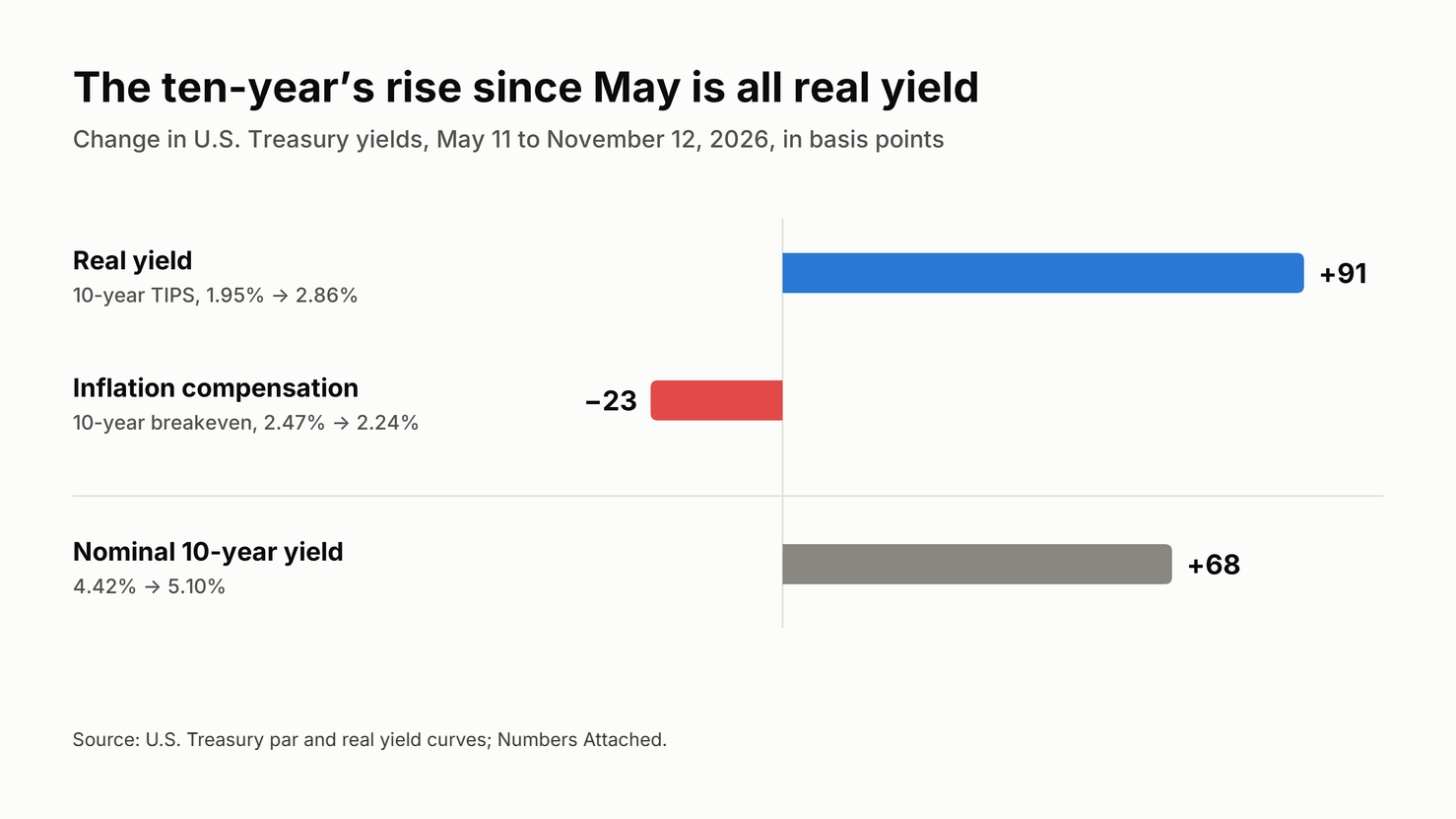
The ten-year Treasury yield crossed 5% in the week of November 9 and closed at 5.10% on Thursday, November 12. The number underneath it matters more. Since May the ten-year real yield has risen from 1.95% to 2.86%, while breakeven inflation has fallen from 2.47% to 2.24%. A bond market worried about inflation asks for a wider breakeven. This one is asking for a higher real return. At the old price, the world wants to borrow more than it wants to save.
Growth explains part of the move. The economy grew at a 3.4% annual rate in the third quarter and productivity at 3.6%, and a faster economy should pay a higher real rate. Policy does not explain the rest. The funds rate is 3.75% to 4% and headline inflation is near 4%, so the real policy rate is about zero, and financial conditions are looser than average. The gap is the market pricing rate rises the Federal Reserve has yet to deliver, and heavy borrowing.
Two borrowers stand out. One is the Treasury. The other is the AI build-out. By one bank’s count, five large cloud companies have sold about $296 billion of bonds this year, against $108 billion in all of 2025. Count equity as well, and the hyperscalers and AI labs have asked the markets for about $935 billion, of which roughly $187 billion is still planned, pending or unsold. American companies retired more stock than they issued for two decades. This year they are net issuers, and the new shares are coming from the AI spenders.
Some of the demand is financed by the suppliers. The largest chip maker owns stakes in its customers and guarantees their leases. Guarantees are leverage that does not show up as debt, and they sit on nobody’s net-debt screen. That company changed chief executives on November 12, five days before its November 17 earnings report and six days before the scheduled pricing of a $90 billion AI share sale.
Not every large company is in the queue. One megacap skipped the spending race and is being paid for the absence of a funding need. A drug maker and a leading AI lab each bring in roughly $16 billion to $17 billion a quarter, and nobody has to guarantee the drug maker’s customers’ leases.
None of this says the technology will disappoint. The railways and the fibre networks were both built and both were worth having, yet most of the people who financed them at the top were never repaid. An over-build is an argument about who gets paid.
Higher real yields also pay investors to wait. An inflation-protected ten-year Treasury pays roughly 2.9% after inflation, and every long-dated promise now has to beat that. The view would change if real yields fell back toward 2% with inflation expectations steady, if free cash flow at the largest spenders turned positive without a cut in capital spending, or if the debt-funded share of that spending fell back below a quarter. Until then, the question to put to any AI exposure, public or private, is the same: who is paying for the time?
This summary is general information only. It is not investment, tax or legal advice, and it is not a recommendation to buy or sell any security. It is not an offer or solicitation for any security, fund interest or advisory service. Views are as of the date shown and may change without notice. Vigo Capital, its principals and its clients may hold positions related to the themes discussed. Investing in bonds, equities and derivatives involves risk, including loss of principal. Past performance is not indicative of future results.