

Summary of an essay first published on Substack on November 23, 2026.
Update, November 23: after the essay was published, the chip maker’s board reinstated its founder as chief executive, and the stock rose about 31% on the day. The two paragraphs on the company describe the position as of November 20.
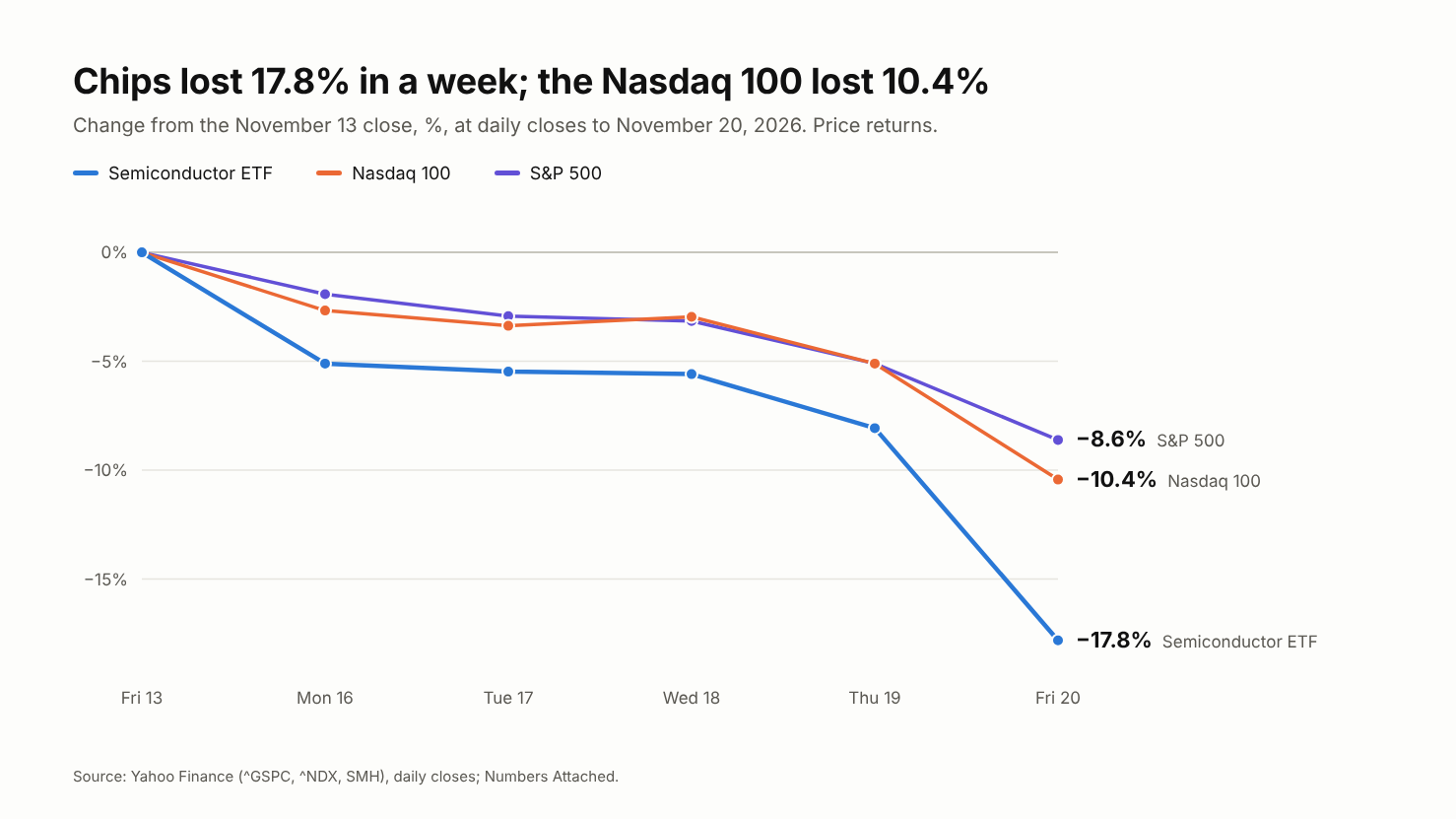
The price of time has gone up. A thirty-year Treasury Inflation-Protected Security (TIPS) pays about 3.2% over inflation, and five years ago it paid less than nothing. In the week to November 20 that repricing reached the equities valued on distant profits, which is most of the AI trade. The S&P 500 lost 8.6%, the Nasdaq 100 lost 10.4% and a large semiconductor exchange-traded fund lost 17.8%. The S&P 500 is 11.6% below its October 6 record and the Nasdaq 100 is 19.8% below its own. A rising real yield cuts the value of a 2035 profit long before it touches a 2027 one.
The options market shows what kind of fear this is. One-week implied volatility on the Nasdaq 100 closed on Friday, November 20, at 56%, double the level of a week earlier, which prices daily moves of about 3.5%. Two-year implied volatility rose from about 24% to 26%. The market is paying up for the next two weeks, not repricing the next two years.
Leverage has already produced casualties. One prominent AI-focused hedge fund lost 67% in July and had to sell most of its public portfolio. Its latest quarterly filing shows $1.6 billion of public holdings at the end of September against $20.2 billion in June, three-quarters of it in three names and mostly in call options. Credit is harder to come by for data centers: one of the strongest operators recently raised $300 million of the $800 million it wanted rather than pay a higher rate. A well-known macro investor told a conference that he is nearly flat on stocks, because the conditions that made him bullish in January have reversed: the Federal Reserve is raising rates, commodities are weakening and credit spreads are widening.
The largest chip maker has had the worst of it. Its founder and chief executive resigned on November 12, the Securities and Exchange Commission is reportedly examining whether the company’s disclosures misled investors, and the stock fell 14% on November 20 alone, leaving it 48% below its October high. In the author’s view the board moved quickly under public pressure, and the market cannot yet judge how much of the company’s edge rested with one person. A precedent from 2018 is not encouraging. Another large chip maker replaced its chief executive with its finance chief; from the eve of that change to November 20 its stock is down 4%, while the Philadelphia semiconductor index is up about 500%.
Prices have adjusted. The company has just reported revenue up 103% on a year earlier. On the day its chief executive left, it traded at about 12 times forward earnings, the cheapest since 2012 by one data provider’s count, and the stock is more than 20% lower now. Cheap is not a floor. As one newspaper columnist has pointed out, the same stock had fallen 62% from its high by the end of 2000, and a large networking-equipment maker, down by half over the same stretch, halved again in the first quarter of 2001.
Private markets face the same higher price of time, and late-stage rounds at high valuations will be harder to raise. The essay is constructive on one part of that market: companies built on science. In the week semiconductor shares fell, two of them closed large financings. An AI drug-design company raised $5 billion, six months after a $2.1 billion round, and a brain-computer interface company raised $400 million, eight months after a $230 million round. Money still finds science; it is hype that has to look for buyers. Private-market investments in general are speculative and illiquid, and investors can lose all of the capital they invest.
The essay’s conclusion borrows a rule from a well-known macro strategist: always own beta. Beta here is the long-only book, the assets held all the time in order to be paid more than cash. An asset has to pay more than cash or nobody would hold it, so a diversified long-only book collects that extra pay over time. It does not do so every year: so far in 2026 cash has beaten stocks, bonds and gold. The rule cuts both ways. If bonds do not pay for their risk, they do not belong in a portfolio. In 2020 the term premium fell to minus 0.65%, and by late 2021 a thirty-year TIPS yielded minus 0.5%; the selloff that followed was the bill. The same maturity now pays about 3.2% over inflation.
The rule comes with two conditions. The first is balance. The S&P 500 is about three times as volatile as a broad bond index, so a portfolio of 60% stocks and 40% bonds is mostly a bet on stocks. Not surprisingly, diversification across markets and strategies still works. On November 20, while semiconductor shares fell, long Treasuries rose and consumer staples finished higher. The second is size. A position should be small enough that a wrong view costs a bad month and not the portfolio, because a margin call takes the decision out of the investor’s hands. So far the forced selling has been limited to fast money: hedge fund net leverage is the lowest since April 2025, while nearly $170 billion has gone into U.S. equity mutual funds and exchange-traded funds this quarter, by one investment bank’s figures.
The Treasury rally has a mechanism behind it. Part of the term premium is growth expectations, and those are still high: in one bank’s latest survey of fund managers, 3% expected a recession within a year and 41% expected the boom to carry on. If stocks stay at these levels or lower for weeks, expectations of strong real growth are likely to fade, and that part of the premium would come out of long yields. The essay does not call a bottom. The author’s approach is to keep the diversified core in place and to add views on top of it, sized so that a mistake is affordable.
This summary is general information only. It is not investment, tax or legal advice, and it is not a recommendation to buy or sell any security. It is not an offer or solicitation for any security, fund interest or advisory service. Views are as of the date shown and may change without notice. Vigo Capital’s principals and/or accounts and vehicles it advises hold positions in some of the securities described above, including the semiconductor exchange-traded fund and the brain-computer interface company, and may buy or sell them at any time without notice. A position in the chip maker, held when the essay was published, was sold on November 23, 2026. They may also hold other securities discussed, including TIPS. Investing in bonds, equities, derivatives and private companies involves risk, including loss of principal. Past performance is not indicative of future results.